Welcome:
Language:
 ∷
∷

∷
 ∷
∷

With the continuous development of digital healthcare, medical imaging diagnostic equipment is evolving toward higher accuracy, faster processing capability, and more compact designs.
From large imaging systems used in hospital departments to compact diagnostic devices used in clinics and specialized medical facilities, imaging equipment has become an important tool for clinical diagnosis.
Modern medical imaging equipment is no longer limited to image acquisition. It also performs complex tasks including data processing, signal conversion, image analysis, and system control.
As a result, internal structures increasingly integrate more electronic components, including:
As equipment functions become more complex, the heat generated inside the device increases accordingly.
For medical equipment manufacturers, thermal management has become an important factor affecting equipment reliability.
Unlike industrial equipment, medical imaging devices are often installed in environments where low operating noise is required. Therefore, thermal solutions must not only control temperature but also maintain a quiet operating experience.
The thermal design of medical imaging equipment needs to achieve a balance between:
| Key Requirement | Design Objective |
|---|---|
| Temperature control | Reduce internal heat accumulation |
| Operating stability | Ensure long-term reliability of electronic components |
| Noise control | Meet quiet medical environment requirements |
| Service life | Reduce maintenance frequency |

Although medical imaging equipment usually operates in controlled indoor environments, its operating characteristics still create several thermal management challenges.
In hospitals and diagnostic centers, imaging equipment often needs to operate continuously throughout the day.
During operation:
All these processes generate heat.
If internal airflow is insufficient, heat may accumulate in specific areas, causing internal temperature increases.
Long-term temperature rise may affect:
Modern medical equipment is becoming smaller and more integrated.
Within limited internal space, engineers must complete:
Reduced internal space may result in:
Therefore, thermal solutions must effectively manage heat transfer within limited installation space.
Compared with industrial equipment, medical devices place greater emphasis on user experience.
Medical imaging systems are commonly installed in:
If the cooling system generates noticeable noise, it may affect the overall user experience.
Therefore, during product development, manufacturers need to consider:

Understanding the internal heat sources is the foundation for developing an effective thermal management solution.
Different components generate heat through different mechanisms and require different cooling approaches.
| Heat Source Component | Heat Generation Cause | Cooling Requirement |
|---|---|---|
| Image processing module | High-speed computing and signal processing power consumption | Reduce chip temperature and maintain processing stability |
| Control module | Continuous operation of electronic components | Maintain control system reliability |
| Power module | Energy conversion losses during current transformation | Remove heat and improve reliability |
| Drive components | Mechanical and electrical losses during operation | Control operating temperature |
| Communication module | Heat generated during data transmission | Maintain communication stability |
In practical equipment structures, heat is often concentrated around several key areas.
Simply increasing cooling component performance cannot fully solve temperature issues.
A complete thermal design should consider:

For medical imaging equipment, insufficient cooling may not immediately cause system failure, but long-term exposure to elevated temperatures can affect reliability.
Electronic components operating continuously at higher temperatures may experience changes in performance.
Possible effects include:
Medical imaging equipment relies on multiple electronic modules working together.
Temperature fluctuations may influence:
Medical equipment is expected to provide reliable service over long lifecycles.
Poor thermal design may increase:
Therefore, thermal planning during the early product development stage is important for improving overall equipment reliability.
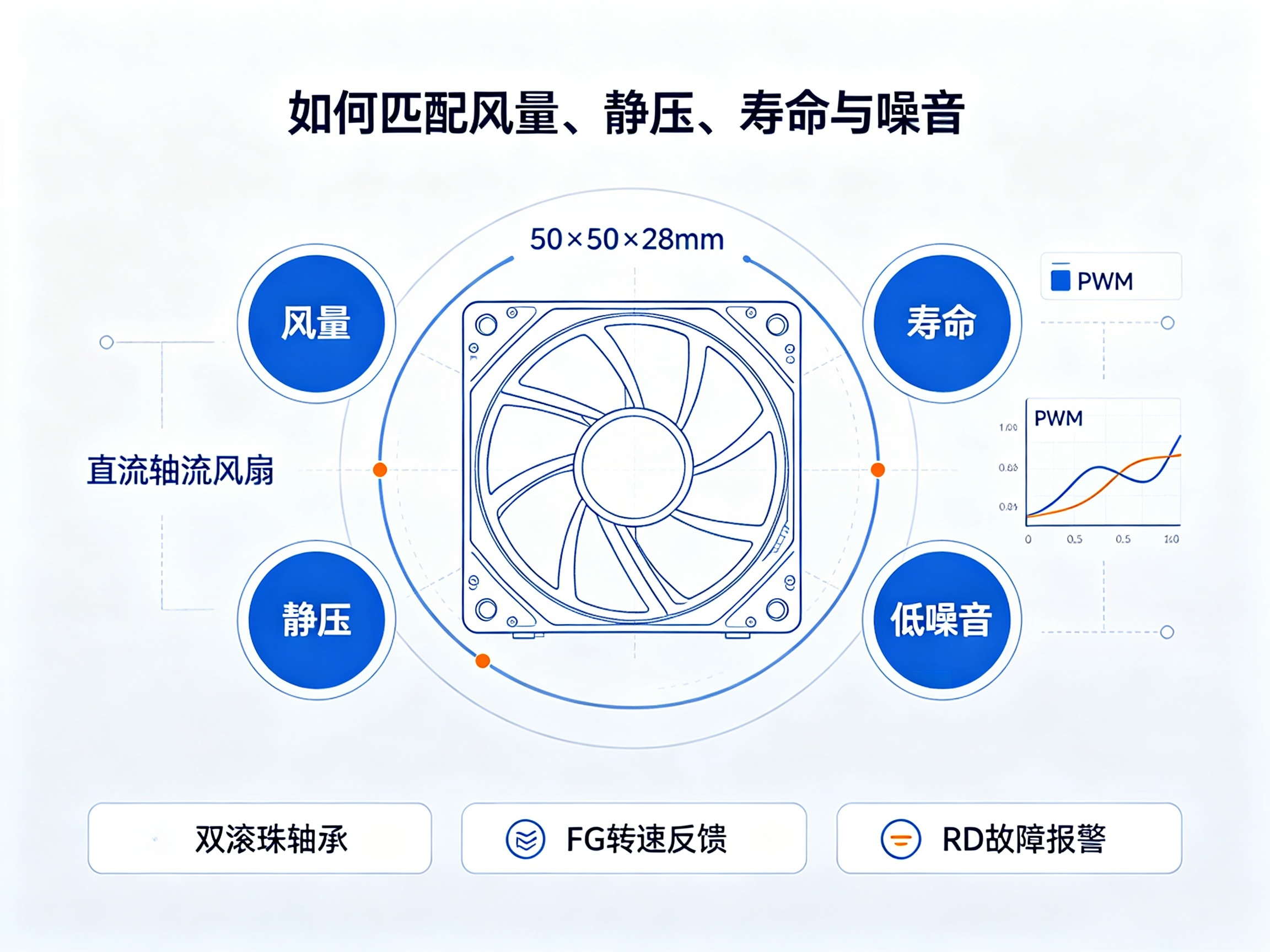
Based on the characteristics of medical imaging devices, thermal systems generally need to meet several requirements.
Airflow determines the efficiency of heat exchange.
During design, airflow should be selected according to:
Insufficient airflow may not remove heat effectively, while excessive airflow may increase operating noise.
Inside medical equipment, airflow may be affected by:
These structures increase airflow resistance.
Therefore, cooling components must provide not only sufficient airflow but also adequate static pressure to ensure effective air circulation through complex internal structures.
Medical equipment generally requires long-term stable operation.
Thermal components should consider:
This helps reduce maintenance caused by cooling component failure.
Medical environments are sensitive to noise.
Thermal design should consider:
The goal is to achieve a balance between cooling performance and quiet operation.
PWM speed control technology allows cooling performance to be adjusted according to actual equipment operating conditions.
For example:
During low-load operation, fan speed can be reduced to minimize noise.
During high-load operation, airflow can be increased to improve cooling performance.
This helps balance:

For medical imaging equipment with limited internal space, concentrated heat sources, and strict noise requirements, forced-air cooling is commonly used as an effective thermal management approach.
In practical applications, cooling fans should not simply be selected based on maximum airflow. Instead, selection should be based on the complete equipment structure.
For example:
For compact control modules, a 50×50×28mm DC axial fan can be used. By matching airflow and static pressure characteristics, it can provide effective cooling performance within limited space.
This type of cooling fan generally features:
It can be applied in:
For different medical imaging devices, thermal design should consider:
| Design Factor | Consideration |
|---|---|
| Equipment size | Determine suitable fan dimensions |
| Heat generation | Match required cooling capacity |
| Airflow structure | Select appropriate static pressure performance |
| Noise requirements | Optimize speed and operating conditions |
| Application environment | Consider protection requirements |
Through systematic matching, equipment manufacturers can achieve a balance between low noise, efficient cooling, and long-term reliability.

Shenzhen Jentech Electronic Co., Ltd. was established in September 2010 and is located in Longhua, Shenzhen, China. The company is a comprehensive thermal management solution provider specializing in cooling fan development, manufacturing, and application services.
Jentech has developed a dual-track business model combining international brand distribution and independent manufacturing capabilities.
The company is an authorized distributor of Japanese SANYO DENKI San Ace cooling fans and Taiwan AVC cooling fans, while also developing its own JEANTECH cooling fan series to provide both standard products and customized thermal solutions.
Jentech focuses not only on supplying cooling fans but also on providing application-oriented engineering support, including:
The company operates a smart manufacturing facility of more than 3,000㎡ equipped with:
Jentech has established comprehensive testing capabilities, including:
Its products comply with UL, CE, TUV certification requirements and meet RoHS standards.
With extensive experience in industrial applications, Jentech provides thermal management solutions for industries including medical equipment, industrial automation, new energy, communication systems, and precision instruments.
As medical imaging equipment continues to develop toward higher performance, smaller size, and quieter operation, thermal management has become an essential part of equipment reliability design.
For equipment manufacturers, an effective cooling solution is not simply about increasing airflow. It requires balancing:
Through professional thermal analysis and application support, medical imaging equipment can achieve more stable long-term operation and provide reliable performance throughout its lifecycle.
台湾jamicon风扇、San Ace山洋散热风扇,AVC风扇,jentech风扇
Contact:
Phone: 18124620466
Tel: 0755-23706799
Email: yq@jentech.cn
Add: