Welcome:
Language:
 ∷

∷
 ∷

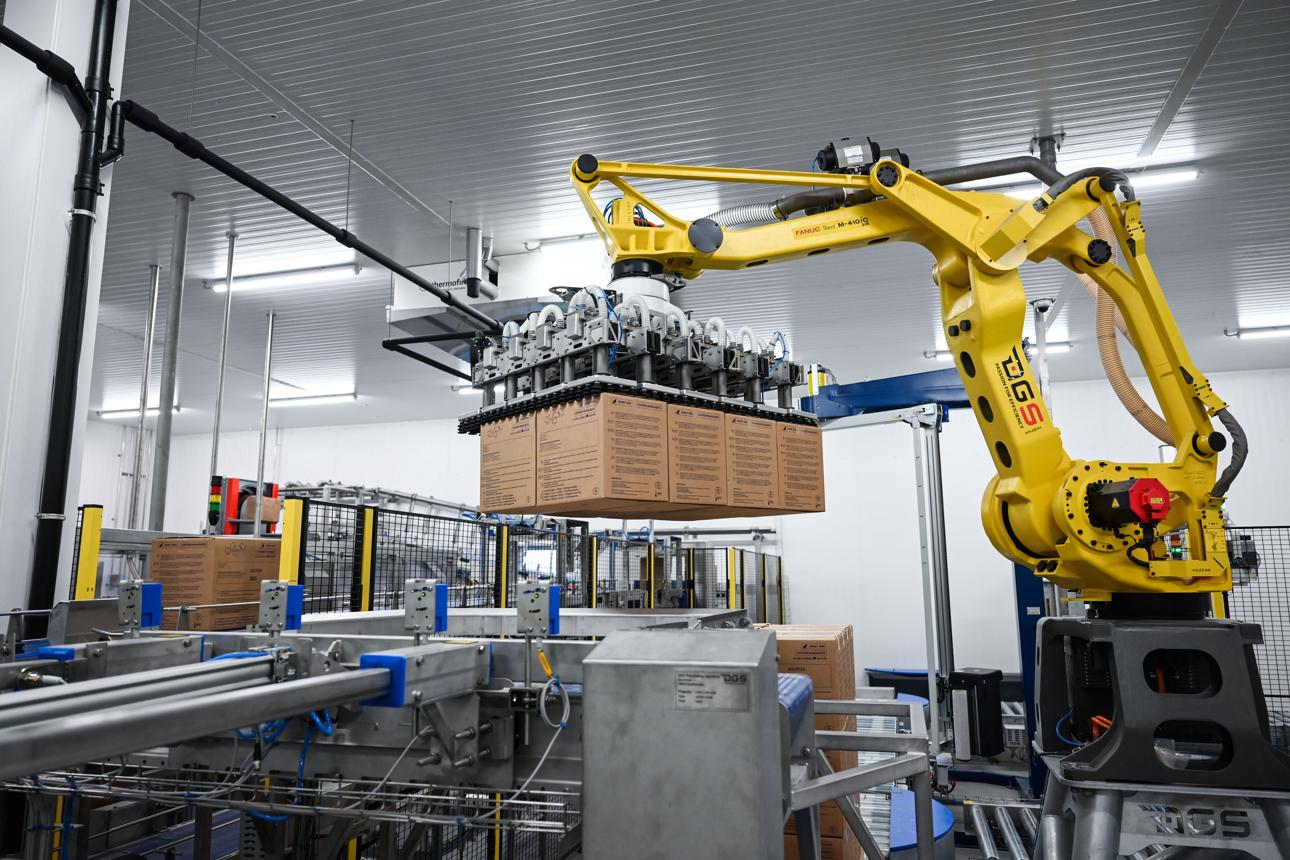
Palletizing robots are widely used in automated manufacturing and logistics systems. They perform continuous operations such as picking, handling, positioning, and stacking cartons, bags, and other materials onto pallets. During extended operation, the servo drives, inverters, power supplies, PLC controllers, and communication modules inside the robot control cabinet generate heat.
If this heat cannot be dissipated effectively, the internal cabinet temperature may rise, potentially affecting the operating stability of electronic components. In demanding applications, excessive temperature can also contribute to equipment derating, unexpected alarms, and increased maintenance requirements.
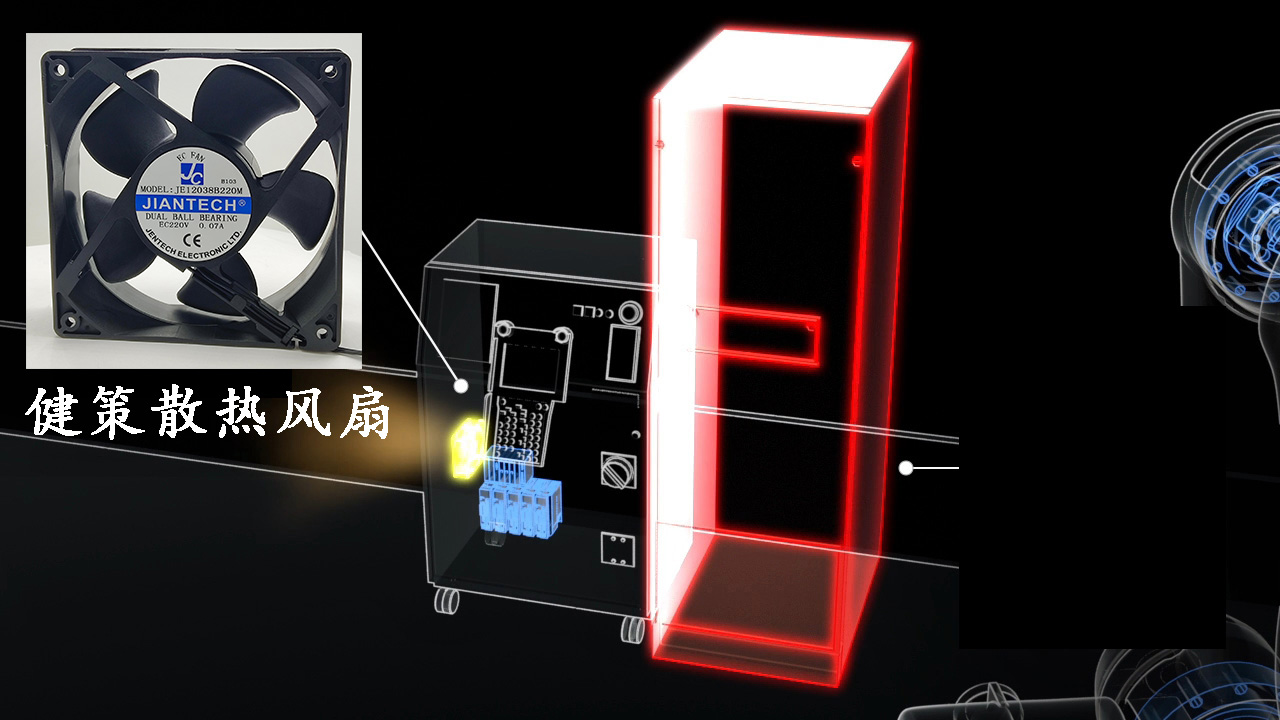
For this reason, cooling a palletizing robot control cabinet involves more than simply installing a fan. Engineers need to consider the power supply, motor drive architecture, airflow requirements, system impedance, installation conditions, and long-term operating reliability.
To address these requirements, JENTECH offers the JE12038 ACDC/EC cooling fan series, featuring a 120 × 120 × 38 mm form factor and a 100–240V AC wide-input design. From electrical input and electronic drive design to fan structure, manufacturing, and performance verification, JENTECH focuses on providing cooling solutions for industrial equipment.
A palletizing robot may operate for long periods according to a predefined production cycle. Its control cabinet contains multiple electrical and electronic components, each contributing to the overall thermal load.
Different components generate heat in different ways, and their positions inside the cabinet directly affect the cooling requirements.
| Control Cabinet Component | Main Heat Sources | Cooling Considerations |
|---|---|---|
| Servo drives | Power semiconductor losses and motor drive operation | Maintain effective airflow around heat-generating components |
| Inverters | Power modules, rectifier circuits, and switching losses | Provide sufficient heat removal during continuous operation |
| Switching power supplies | Energy conversion losses | Prevent heat accumulation around power modules |
| PLC controllers | CPU and internal electronic components | Maintain a suitable operating temperature |
| Communication modules | Communication chips and electronic circuits | Reduce localized temperature rise and improve air circulation |
The internal layout also influences cooling performance. Cable ducts, mounting rails, partitions, filters, and protective grilles can obstruct airflow and increase system resistance.
For example, a fan installed on the cabinet door may draw air into the enclosure, but the airflow may not pass directly through the servo drives or power modules. If the intake and exhaust positions are poorly arranged, localized air recirculation or stagnant areas may develop.
An effective cooling design should therefore address three basic questions:
Where is the heat generated? Identify the main heat-generating components and their locations.
How does the air move through the cabinet? Establish an airflow path that passes through the critical thermal areas.
How is the heat discharged? Select fan performance according to the thermal load and airflow resistance.
The purpose of a cooling fan is not simply to circulate air inside the enclosure. It is to establish an effective airflow path that carries heat away from critical components.
Industrial equipment does not always use the same power supply architecture. Some control cabinets provide suitable DC power, while others are designed around an AC power distribution system.
An ACDC fan provides an alternative for applications where an AC input is preferred.
The JENTECH JE12038 series is designed for a 100–240V AC wide-input range. Inside the fan, power conversion and electronic drive circuitry supply the electrical power required by the brushless motor.
The basic operating process can be described as:
AC power input → Internal power conversion → Electronic motor drive → Impeller rotation → Directed airflow.
It is important to distinguish between the terms ACDC and EC.
ACDC describes the fan's AC input and internal power conversion arrangement. EC refers to electronically commutated motor technology and its associated electronic drive. These terms are related in many product designs, but they do not necessarily describe identical internal circuit architectures. The specific design and functions should always be confirmed against the relevant product specifications.
| Comparison | Conventional AC Fan | DC Fan | ACDC/EC Fan |
|---|---|---|---|
| Typical input | AC power | DC power | AC power input |
| Internal drive | Depends on product design | Electronic drive | Internal power conversion and electronic drive |
| Power supply arrangement | Requires compatible AC supply | Requires compatible DC supply | Can reduce the need for a separate external DC supply |
| Typical application consideration | Existing AC power architecture | Equipment with an available DC supply | Applications preferring direct AC input |
| Key selection factors | Voltage, frequency, airflow, and static pressure | Voltage, drive characteristics, airflow, and static pressure | Input range, power consumption, drive functions, airflow, and static pressure |
For a palletizing robot control cabinet, an ACDC/EC fan can simplify the fan power arrangement when a compatible AC supply is already available. It may reduce the need for an additional external DC power supply dedicated to the cooling fan.
However, this does not mean that ACDC/EC fans are always the best choice. If the equipment already provides a suitable DC supply, a DC fan may also be appropriate.
The correct solution should be selected according to the electrical architecture and cooling requirements of the complete machine, rather than the fan category alone.
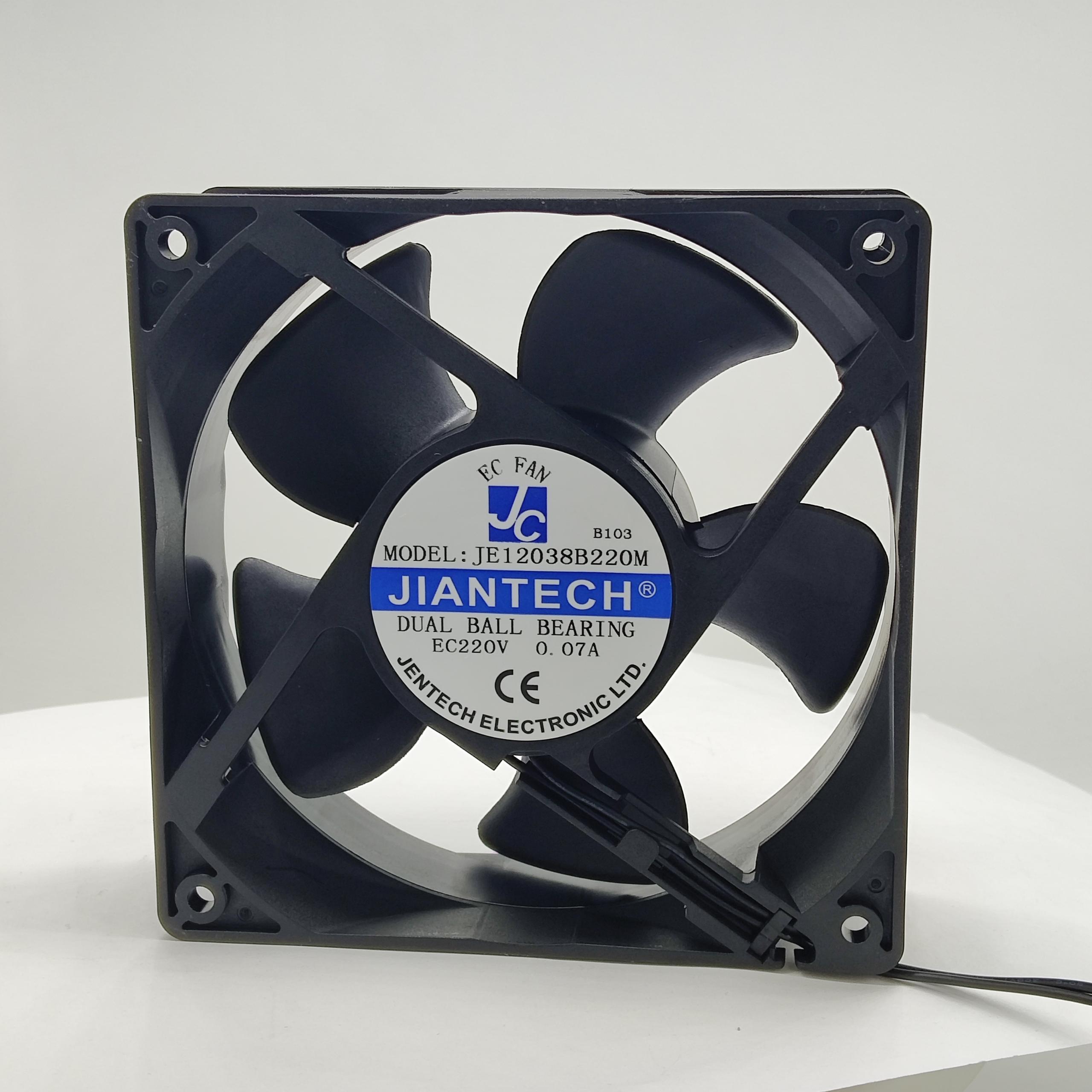
The 120 mm fan format is widely used in industrial control cabinets, automation equipment, and electrical enclosures.
The JENTECH JE12038 series features a 120 × 120 × 38 mm frame. Compared with a conventional 120 × 120 × 25 mm fan, the 38 mm thickness provides a different structural design space for the impeller and airflow path. It is an option worth evaluating in applications requiring specific airflow and static pressure performance.
The series uses PBT 94V-0 materials for both the impeller and frame, with a double ball bearing structure. Its operating temperature range is -20°C to 70°C.
Multiple speed versions are available to support different cooling requirements.
| Item | Specification |
|---|---|
| Product Series | JE12038-01 |
| Dimensions | 120 × 120 × 38 mm |
| Input Voltage | 100–240V AC |
| Impeller Material | PBT 94V-0 |
| Frame Material | PBT 94V-0 |
| Bearing Type | Double Ball Bearing |
| Operating Temperature | -20°C to 70°C |
| Product Type | ACDC/EC Cooling Fan Series |
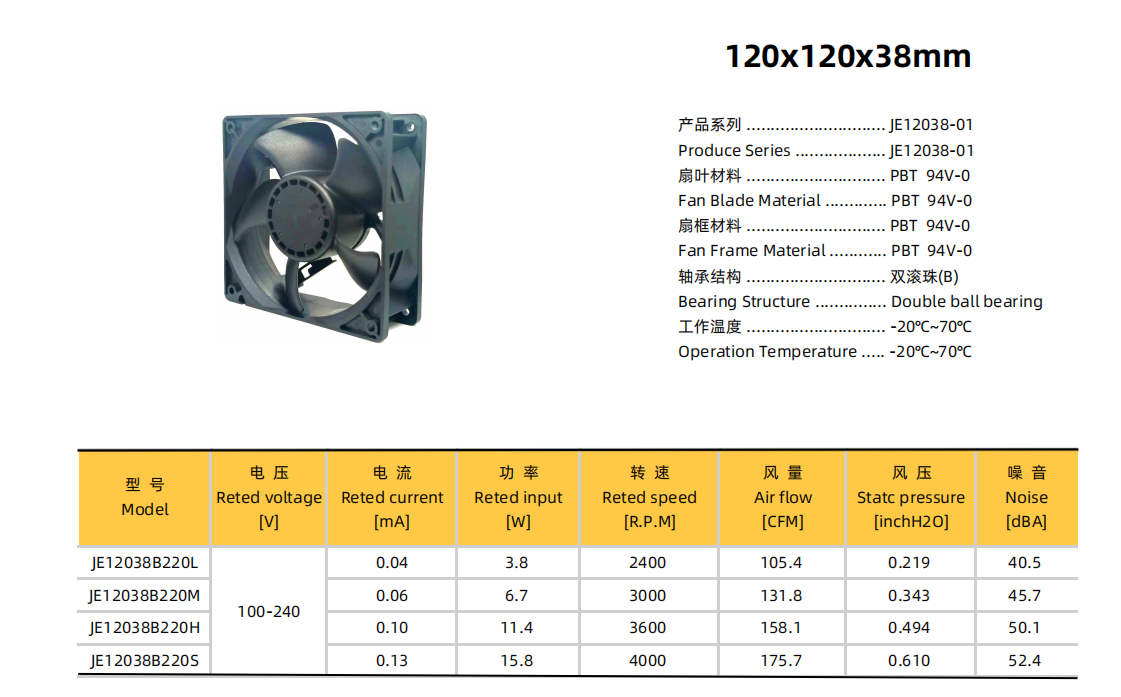
The JE12038 series offers four performance options: L, M, H, and S. Each version provides a different combination of airflow, static pressure, power consumption, and noise level.
| Model | Voltage [V] | Current [A] | Power [W] | Speed [RPM] | Airflow [CFM] | Static Pressure [inchH₂O] | Noise [dBA] |
|---|---|---|---|---|---|---|---|
| JE12038B220L | 100-240 | 0.04 | 3.8 | 2400 | 105.4 | 0.219 | 40.5 |
| JE12038B220M | 100-240 | 0.06 | 6.7 | 3000 | 131.8 | 0.343 | 45.7 |
| JE12038B220H | 100-240 | 0.10 | 11.4 | 3600 | 158.1 | 0.494 | 50.1 |
| JE12038B220S | 100-240 | 0.13 | 15.8 | 4000 | 175.7 | 0.610 | 52.4 |
Note: Current values are presented in amperes based on the supplied specification data. Airflow and static pressure are product performance specifications. Actual airflow after installation depends on the system resistance.
The four versions have different performance characteristics:
L Version: 2400 RPM and 105.4 CFM. Suitable for evaluating applications with relatively low airflow resistance and greater emphasis on noise and power consumption.
M Version: 3000 RPM and 131.8 CFM. Offers a higher airflow and static pressure option for general industrial cooling requirements.
H Version: 3600 RPM and 158.1 CFM. Worth evaluating for equipment with higher thermal loads and greater airflow requirements.
S Version: 4000 RPM and 175.7 CFM. Provides the highest rated airflow and static pressure among the four versions, but power consumption, noise, and installation conditions should also be considered.
A higher fan speed does not automatically mean better cooling performance for every application. Higher speeds generally involve increased power consumption and noise. The final selection should be based on the fan's actual operating point in the equipment.
Fan selection should begin with an assessment of the cabinet's thermal load and internal airflow layout. The required airflow and static pressure can then be evaluated according to the system resistance.
If the control cabinet contains a relatively small number of servo drives, operates under moderate duty conditions, and has a relatively unobstructed airflow path, the JE12038B220L can be considered as an initial option.
Its rated airflow is 105.4 CFM, with a power consumption of 3.8 W and a noise level of 40.5 dBA.
When the cooling requirement is met, a lower-power fan may help reduce the fan's own energy consumption and operating noise.
For a control cabinet containing multiple servo drives, power modules, and control components, additional airflow capacity may be required.
The JE12038B220M provides a rated speed of 3000 RPM, airflow of 131.8 CFM, and static pressure of 0.343 inchH₂O.
Compared with the L version, it offers higher rated airflow and static pressure, making it a candidate for applications requiring greater air circulation.
Multi-axis robots, high-cycle palletizing systems, and control cabinets with concentrated power electronics may require greater cooling capacity.
In these applications, the JE12038B220H and JE12038B220S can be included in the evaluation.
The H version provides 158.1 CFM of rated airflow, while the S version provides 175.7 CFM. Both offer higher rated static pressure than the L and M versions.
However, if the cabinet uses dense air filters, narrow ventilation passages, or multiple internal partitions, simply increasing fan speed may not deliver the expected airflow. The airflow path and possible obstructions should also be examined.
| Control Cabinet Conditions | Models to Evaluate | Main Considerations |
|---|---|---|
| Lower thermal load and higher noise sensitivity | JE12038B220L | Power consumption, noise, and basic ventilation requirements |
| General multi-axis robot control cabinet | JE12038B220M | Balance between airflow and static pressure |
| Multiple drives and concentrated heat sources | JE12038B220H | Increased airflow capacity |
| Higher thermal load and greater airflow resistance | JE12038B220S | Higher rated airflow and static pressure, subject to operating-point verification |
These recommendations are intended for preliminary model screening. They are not fixed selections for every palletizing robot. Final selection should be verified against actual temperature rise, system resistance, mounting conditions, and noise requirements.

The maximum airflow shown in a fan specification does not represent the actual airflow after the fan is installed in a control cabinet.
On a fan performance curve, maximum airflow generally occurs near the free-air condition, where static pressure approaches zero. Maximum static pressure occurs near the shut-off condition, where airflow approaches zero.
These are two different operating points on the fan performance curve. A fan cannot deliver its maximum airflow and maximum static pressure simultaneously.
Once installed, air must pass through filters, grilles, internal components, partitions, and exhaust openings. These elements create system resistance.
The actual operating point is determined by the intersection of the fan's PQ performance curve and the system resistance curve.
For this reason, fan selection should consider the following factors:
| Factor | Impact on Cooling | Selection Considerations |
|---|---|---|
| Air filter | Dust accumulation may increase intake resistance | Select an appropriate filter and establish a cleaning schedule |
| Protective grille | Dense grille structures may restrict effective airflow | Avoid excessive obstruction and insufficient ventilation area |
| Internal cable ducts | May block airflow and create localized hot spots | Plan the airflow path around critical heat sources |
| Intake and exhaust positions | Poor arrangement may cause airflow short-circuiting or recirculation | Arrange the airflow to pass through the main heat-generating areas |
| Exhaust opening area | Restricted exhaust flow increases system resistance | Ensure that intake and exhaust passages are properly matched |
For palletizing robot control cabinets, prototype temperature-rise testing is recommended. Particular attention should be paid to the temperature around servo drives, power modules, and controllers.
Where testing equipment is available, airflow, air velocity, and fan operating-point measurements can also be used to evaluate whether the selected fan is delivering the required cooling performance.
For industrial cooling fans, product quality is not determined by rated airflow and rotational speed alone.
From AC power input to motor operation and impeller airflow output, multiple aspects need to be considered, including electrical design, electronic drive, mechanical structure, material selection, assembly, and performance testing.
As an industrial cooling fan manufacturer, Shenzhen JENTECH Electronics Co., Ltd. focuses not only on whether a product meets its specified parameters, but also on whether it is suitable for the customer's actual equipment application.
ACDC/EC fans require careful consideration of the AC input range, internal power conversion, drive circuitry, and motor operating conditions.
During product development, the electrical design should be evaluated according to the intended application, including input voltage range, power consumption, starting performance, and operating stability.
For a palletizing robot control cabinet, the equipment's power circuit must also be checked to ensure that the fan's input requirements are properly supported.
The impeller affects not only airflow but also static pressure, noise, and overall operating characteristics.
The JENTECH JE12038 series uses PBT 94V-0 materials for the impeller and frame, together with a double ball bearing structure, for industrial cooling applications.
During manufacturing, the fit and assembly condition of the impeller, frame, and motor components also require attention. Assembly deviations may affect the fan's operating performance.
JENTECH has been engaged in the industrial cooling fan industry since 2010, with capabilities covering product development, manufacturing, and testing.
With more than 3,000 m² of digitalized production facilities, JENTECH supports the manufacturing and supply of industrial cooling fan products.
From material and structural component verification to motor assembly, complete fan assembly, performance inspection, and outgoing quality control, manufacturing processes need to follow appropriate requirements to maintain product consistency.
For industrial customers purchasing in volume, product evaluation should not stop at a single prototype. Consistency between production batches and stable delivery capability are also important considerations.
Individual fan performance testing cannot replace complete equipment validation.
Depending on the product specifications and customer requirements, relevant inspection and testing may include:
| Test or Inspection Item | Main Evaluation Focus |
|---|---|
| Electrical input inspection | Input voltage, operating current, and power consumption |
| Speed measurement | Whether fan speed meets the specified requirements |
| Airflow and static pressure testing | Whether aerodynamic performance meets the design requirements |
| Noise testing | Operating noise level |
| Operating condition inspection | Starting, continuous operation, and abnormal operating conditions |
| Temperature verification | Operation within the specified temperature range |
For palletizing robot control cabinets, individual fan testing should be combined with complete cabinet temperature-rise testing.
Only after the fan has been installed and evaluated in the actual equipment can its suitability for the cooling application be properly assessed.

For equipment manufacturers, cooling fan selection involves more than comparing product specifications. Supply capability, customization, delivery, and technical support are also important.
The JENTECH JE12038 series offers several features worth considering:
| Product Feature | Potential Application Value |
|---|---|
| 100–240V AC wide input | Supports compatible AC power systems and can reduce the need for a separate external DC supply |
| 120 × 120 × 38 mm frame | Suitable for industrial equipment with matching installation space |
| Four speed options | Allows performance screening according to thermal load and system resistance |
| Double ball bearing | Suitable for applications where continuous operating performance is an important consideration |
| PBT 94V-0 impeller and frame | Meets the corresponding material specification |
| -20°C to 70°C operating temperature | Provides a defined temperature range for application evaluation |
In addition to palletizing robot control cabinets, the 12038 ACDC/EC fan series can also be evaluated for industrial robot control boxes, automated packaging machinery, conveyor and sorting systems, electrical control cabinets, inverters, and other industrial equipment.
Actual suitability depends on the installation dimensions, power supply, airflow resistance, and operating environment. A fan should not be selected solely on the basis of its frame size or rated airflow.
Shenzhen JENTECH Electronics Co., Ltd. was established in 2010 and specializes in industrial cooling fans. The company positions itself as a comprehensive provider of intelligent thermal management solutions.
JENTECH combines product development and manufacturing capabilities with a production facility covering more than 3,000 m² and supporting fan performance testing equipment.
Its product portfolio covers DC, AC, and EC/ACDC cooling fans, including axial fans, blowers, and centrifugal fans, serving a wide range of industrial applications.
For palletizing robots and industrial automation equipment, JENTECH can assist customers with application-oriented product evaluation, including:
Identifying major heat-generating components and estimating the cabinet's thermal load.
Confirming fan dimensions, mounting positions, and intake/exhaust arrangements.
Checking AC or DC power supply requirements.
Evaluating required airflow, static pressure, and noise levels.
Reviewing material, bearing, and operating temperature requirements.
Supporting product performance evaluation and complete equipment cooling verification.
For equipment manufacturers with volume purchasing requirements, special specifications, or customized development needs, JENTECH can also discuss product structure, performance parameters, and manufacturing arrangements.
From electrical power input to impeller airflow output, and from individual fan performance to cooling inside the complete machine, JENTECH focuses on combining manufacturing capabilities with application-oriented engineering support.
JENTECH specializes in industrial cooling fan development and manufacturing, providing cooling products and application support for palletizing robots, industrial automation equipment, and electrical control systems.
Contact:
Phone: 13322980502
Tel: 0755-23706799
Email: hxp@jentech.cn
Add: