Welcome:
Language:
 ∷
∷

∷
 ∷
∷

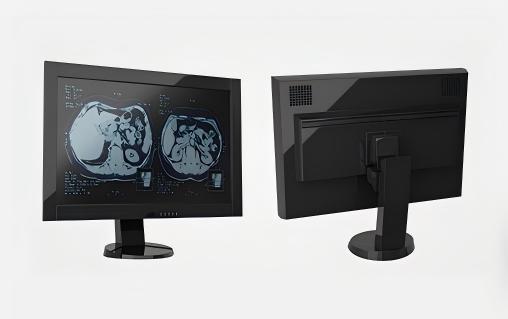
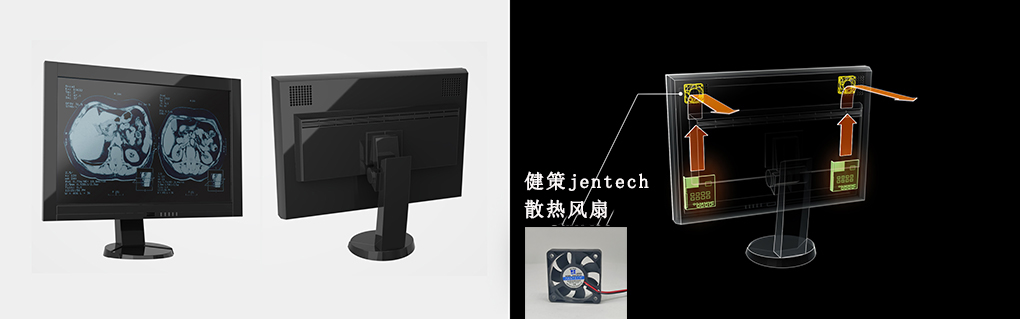
As medical display systems move toward higher resolution, compact designs, and improved performance, the available internal space for thermal management is becoming increasingly limited. At the same time, medical applications often have strict requirements for operating noise, vibration, and long-term reliability.
This means that cooling fans for medical displays cannot simply be selected based on maximum airflow.
A suitable cooling solution needs to consider multiple factors, including:
Airflow, static pressure, noise, vibration, service life, fan size, voltage, control functions, and environmental protection.
JENTECH has developed its own cooling fan product portfolio around these requirements, including DC axial fans and DC blowers, with multiple sizes and voltage options. Customized solutions are also available according to equipment structure, thermal load, and control requirements.
Medical displays are used in environments that can be significantly more sensitive to noise than typical industrial applications.
Because a cooling fan may operate continuously, excessive airflow or mechanical noise can become noticeable during equipment operation.
Therefore, the ideal cooling fan for a medical display is not necessarily the fan with the highest speed.
The goal is to achieve an appropriate balance between:
Cooling performance and operating noise.
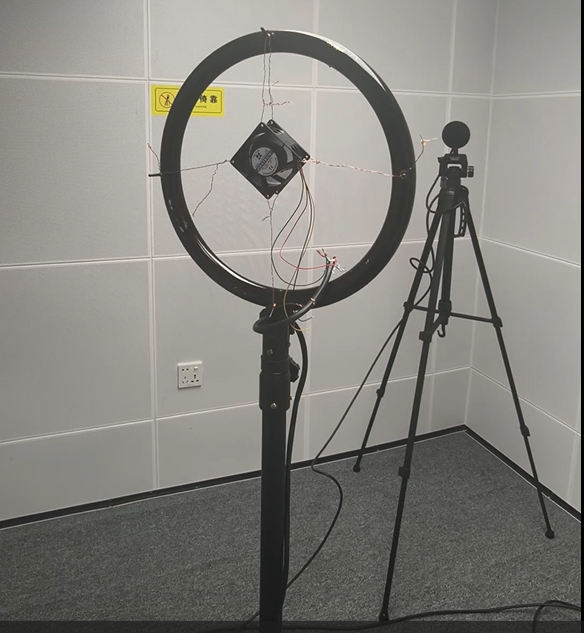
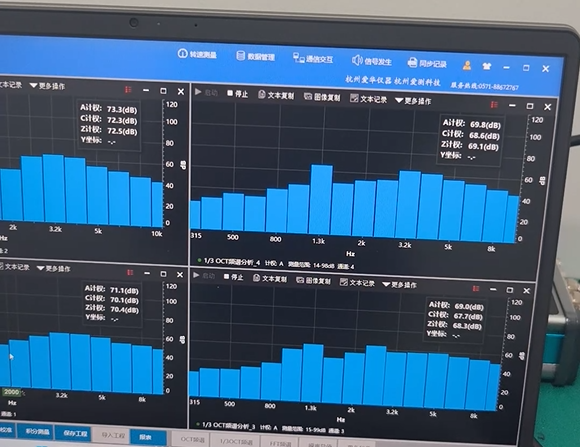
JENTECH focuses on low-noise cooling fan development and manufacturing, with attention to fan impeller design, motor operation, and dynamic balancing.
Noise testing equipment is also used to evaluate fan operating performance.
In an actual medical display application, the appropriate fan specification should be selected according to the thermal load and airflow resistance of the equipment rather than simply increasing fan speed to obtain more cooling capacity.
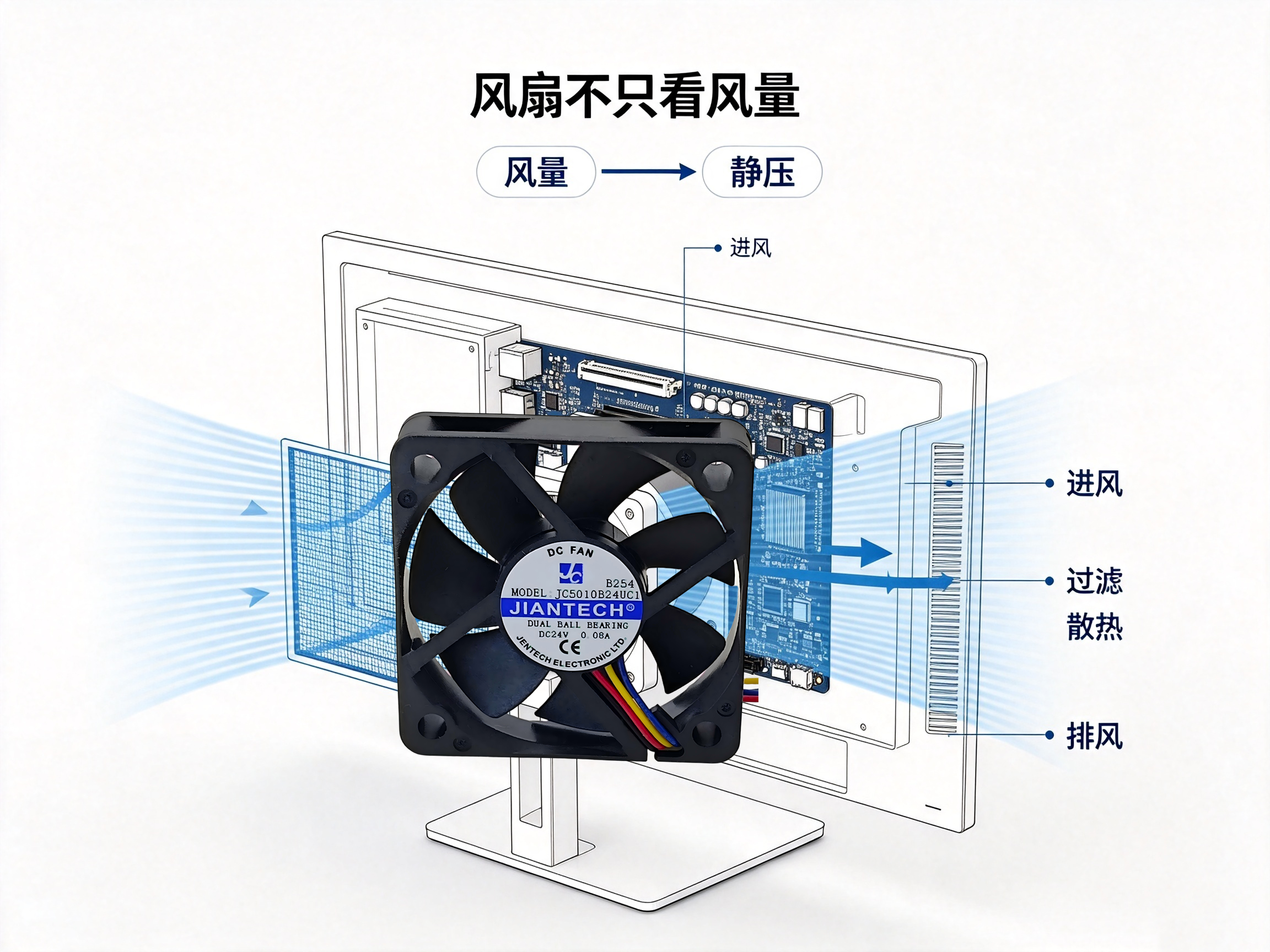
Airflow is one of the most important parameters when selecting a cooling fan.
However, once the fan is installed inside a medical display, its actual operating condition is affected by the internal airflow path.
For example, the equipment may contain:
Limited intake openings
Restricted exhaust paths
Compact internal structures
Dust filters
Heat sinks
Closely arranged electronic components
All of these factors can increase airflow resistance.
Therefore, JENTECH cooling fans should not be selected solely according to their maximum airflow rating. The actual airflow path and thermal load of the equipment should also be evaluated.
A simple way to understand this is:
Airflow determines the fan's air-moving capability, while static pressure determines its ability to maintain airflow against system resistance.
For medical displays with compact internal structures, both airflow and static pressure need to be evaluated.
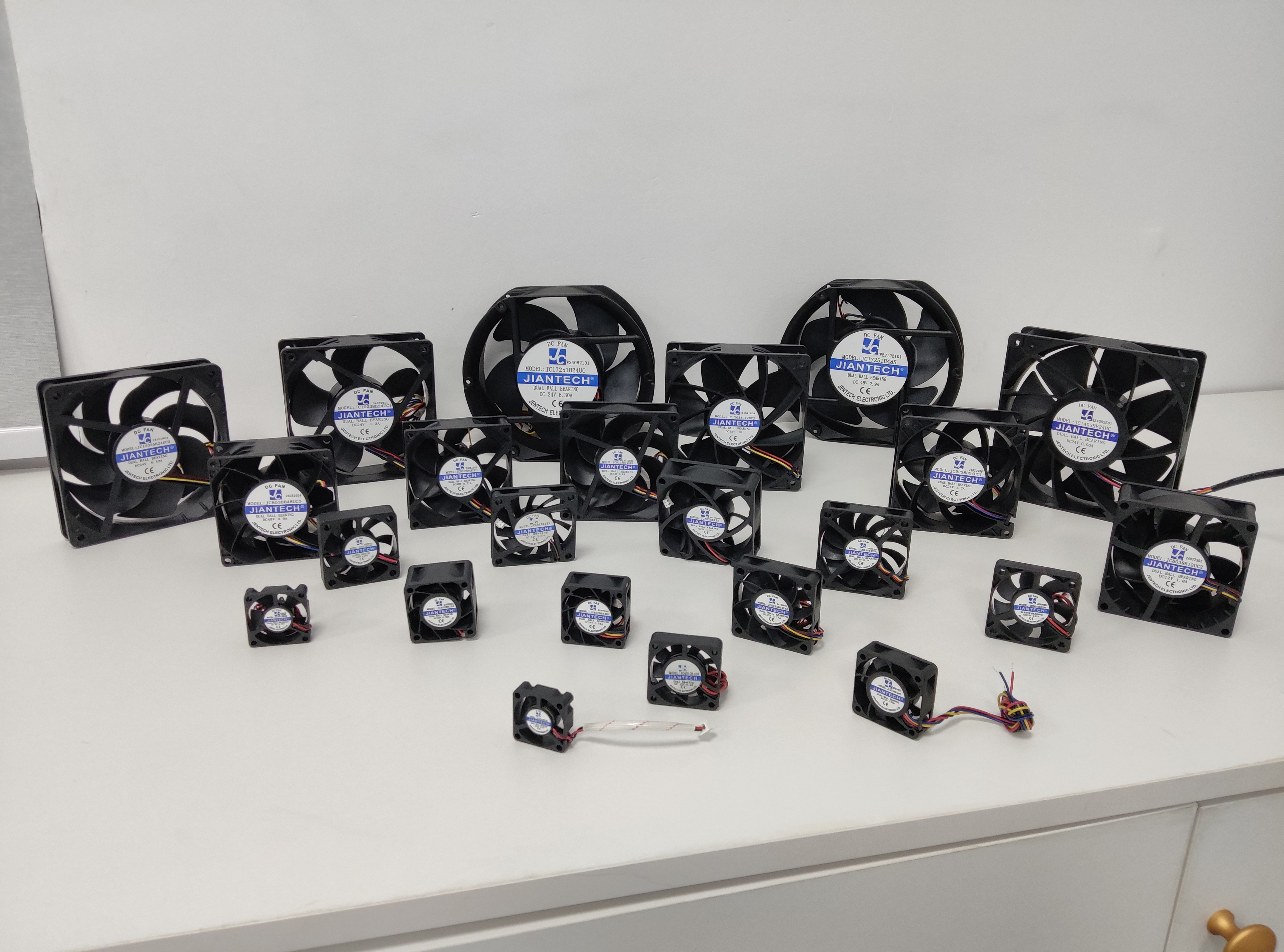
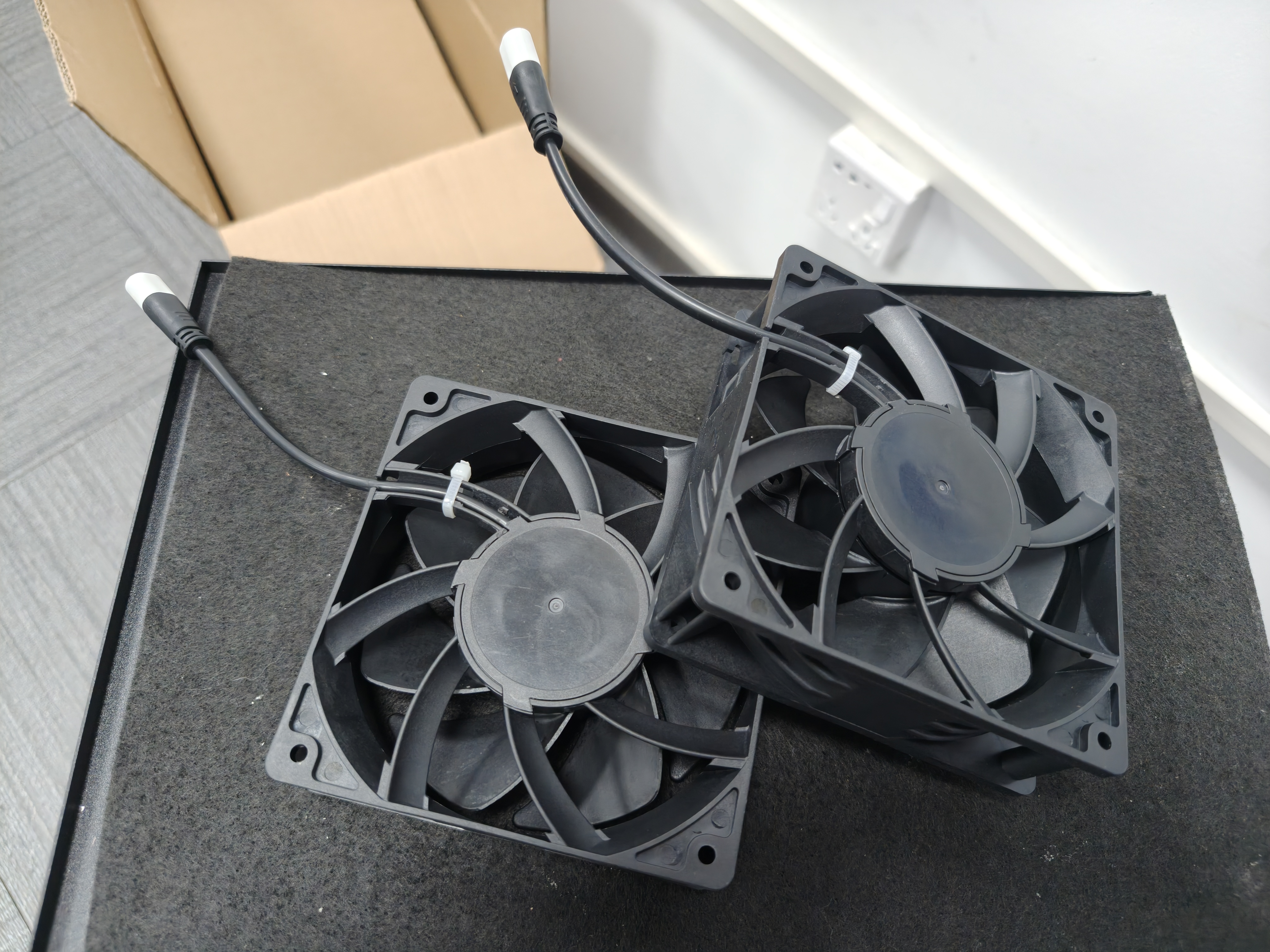
DC axial fans are commonly used for forced-air cooling in electronic equipment.
Air moves axially through the fan, making axial fans suitable for equipment with relatively clear intake and exhaust paths.
For medical displays, different frame sizes, thicknesses, and performance specifications can be selected according to the internal structure of the equipment.
JENTECH DC axial fans are available in multiple sizes and specifications to accommodate different equipment requirements.
| Equipment Requirement | Fan Selection Direction |
|---|---|
| Limited internal space | Compact DC axial fan |
| Higher thermal load | Higher-performance fan according to actual requirements |
| High airflow resistance | Focus on static pressure performance |
| Strict noise requirements | Low-noise performance specification |
| Extended operating time | Consider service life and operating reliability |
| Dynamic speed control required | PWM control |
| Fan speed monitoring required | FG speed sensing |
The final fan specification should be verified according to the actual operating conditions of the equipment.
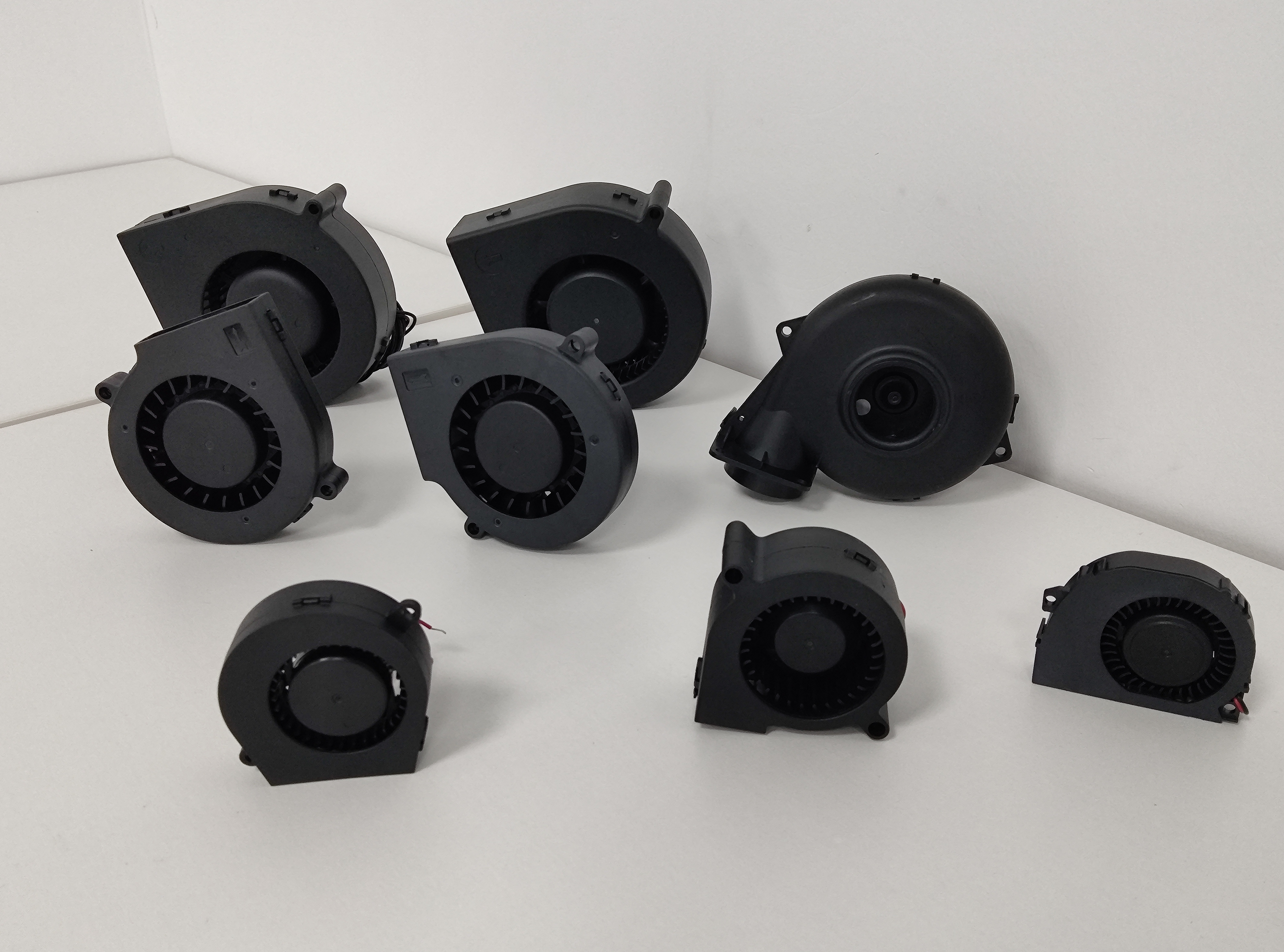
Not every medical display has an internal structure that is suitable for a conventional axial fan.
When internal space is limited or airflow needs to be directed toward a specific area, a DC blower may be a more appropriate solution.
A blower can deliver concentrated airflow through a defined outlet structure.
For example, if a particular electronic module represents a concentrated heat source while the surrounding space is highly constrained, a blower can be combined with an airflow guide to deliver cooling air directly to the target area.
Therefore, thermal design for medical displays should not be limited to a single fan type.
JENTECH's product portfolio includes:
DC axial fans + DC blowers
This allows the cooling structure to be selected according to internal space and airflow requirements.
Medical displays vary considerably in size, internal structure, and thermal load.
A compact medical display and a large professional medical imaging display may have very different cooling requirements.
Using one fan size for every application makes it difficult to balance available space and cooling performance.
JENTECH provides multiple DC cooling fan sizes to help match different equipment structures.
From compact electronic devices to equipment with more available internal space, the appropriate fan can be selected according to the actual thermal requirements.
During fan selection, the key parameters include:
Length × width × thickness + voltage + airflow + static pressure + noise + control function
rather than simply confirming the external dimensions.
Medical display systems can use different internal power architectures, so the fan's rated voltage needs to match the equipment power system.
JENTECH DC cooling fans can be supplied in different voltage specifications according to application requirements.
During an actual project, engineers should confirm more than just the nominal voltage.
Important parameters include:
Rated voltage
Operating voltage range
Rated current
Power consumption
Starting characteristics
Fan speed
Control method
For example, when a display uses a specific DC power system, the fan voltage needs to be compatible with that system, while its current consumption must also be considered during power supply design.
For mass-produced medical displays, these parameters should ideally be verified during prototype testing.
A medical display does not necessarily operate under the same thermal load at all times.
Different display modes, workloads, and ambient temperatures can affect the internal temperature of the equipment.
If a fan operates continuously at maximum speed, it may provide substantial cooling capacity but can also increase noise and power consumption.
PWM speed control provides a way to adjust fan speed according to the equipment's operating condition.
For example:
| Equipment Condition | PWM Control Approach |
|---|---|
| Low thermal load | Reduce fan speed |
| Normal operation | Maintain an appropriate speed |
| Increased thermal load | Increase fan speed |
| Temperature decreases | Reduce speed according to the control strategy |
This allows cooling capacity to respond more closely to the actual thermal requirements of the equipment.
For medical displays, appropriate PWM control can help balance:
Temperature control + noise control + power consumption
For medical displays that operate for extended periods, controlling the fan is not the only requirement.
The equipment may also need to know:
Is the cooling fan operating normally?
Selected JENTECH DC cooling fan models can be configured with an FG speed-sensing function according to project requirements.
The FG signal allows the equipment's control system to obtain fan speed information and evaluate the operating status of the fan.
For example:
Normal speed → Normal operation
Abnormally reduced speed → Warning or protective action
Fan stopped → Corresponding fault handling
In this way, the cooling fan can become part of the thermal management and monitoring system rather than functioning as an isolated cooling component.
Medical displays are generally designed for long service periods, making cooling fan reliability an important consideration.
If the cooling fan fails repeatedly during equipment operation, it can affect thermal performance and increase maintenance requirements.
JENTECH therefore pays attention to factors including:
Motor operating stability
Bearing system
Dynamic balancing
Materials and mechanical structure
Temperature adaptability
Continuous operating capability
The company also has testing capabilities covering thermal shock, high- and low-temperature conditions, waterproof performance, dust protection, and noise.
For an actual medical display project, the required fan service life should be evaluated according to the equipment's operating temperature, duty cycle, and environmental conditions.
Noise is an important specification, but vibration should not be overlooked.
A cooling fan is a rotating mechanical component.
If mechanical vibration is significant during operation, it may be transmitted through the mounting structure to the equipment enclosure.
For medical displays, the cooling fan should therefore be evaluated in terms of:
Noise + vibration + dynamic balance
JENTECH uses automatic dynamic balancing equipment during production to help control the operating stability of rotating fan components.
For medical equipment with demanding operating-quality requirements, low noise and low vibration should be considered together as part of the overall cooling design.
Medical equipment does not always operate under identical environmental conditions.
Some devices are primarily used indoors, while others may encounter dust, moisture, or other environmental factors.
When equipment requires a higher level of environmental protection, the cooling fan should also be evaluated accordingly.
JENTECH can provide cooling fan solutions with corresponding dust- and water-resistant characteristics according to application requirements.
During selection, engineers should consider:
Dust protection requirements
Water protection requirements
Humidity
Operating temperature
Dust exposure
Other environmental conditions
It is important to evaluate protection ratings together with the specific fan design and test conditions rather than treating a protection rating as an independent specification.
Medical displays often have application-specific mechanical structures.
Some equipment may require:
Custom mounting hole patterns
Non-standard dimensions
Special voltage specifications
Custom cable lengths
Special connectors
PWM control
FG speed sensing
Specific noise requirements
Special environmental protection
When a standard fan cannot fully satisfy these requirements, customized development may be considered.
JENTECH can provide customized services according to equipment requirements.
The development process can include fan specification evaluation, sample production, equipment testing, and optimization before mass production.
A typical workflow can be summarized as:
Equipment requirement analysis
↓
Thermal load and installation space evaluation
↓
Fan specification matching
↓
Sample development
↓
System-level testing
↓
Performance optimization
↓
Mass production
This approach is particularly suitable for medical displays and other precision equipment with demanding thermal and operating requirements.
The final performance of a cooling fan depends not only on its design specifications, but also on manufacturing processes and quality control.
JENTECH has a smart manufacturing workshop covering more than 3,000 square meters, equipped with automated winding machines, automatic dynamic balancing equipment, automated assembly lines, and automatic marking and labeling systems.
Production processes are supported by QR-code-based recording and traceability management.
The company also has testing capabilities covering areas such as:
| Testing Capability | Main Purpose |
|---|---|
| Noise testing | Evaluate acoustic performance |
| High- and low-temperature testing | Verify operation under different temperature conditions |
| Thermal shock testing | Evaluate adaptability to temperature changes |
| Waterproof testing | Verify corresponding protection performance |
| Dust testing | Evaluate environmental adaptability |
| Dynamic balancing | Control rotational operating stability |
These capabilities support the development, verification, and production of JENTECH cooling fan products.
From an engineering perspective, the selection process can follow several basic directions.
Consider a compact DC axial fan or DC blower according to the airflow structure.
Evaluate static pressure and the actual operating point rather than comparing free-air airflow alone.
Select an appropriate low-noise specification and verify the result within the actual equipment.
Select a fan with PWM control capability.
Select a model with FG speed sensing or another suitable monitoring function.
Select an appropriate fan according to the environmental protection requirements.
Consider customized fan development for dimensions, voltage, cable configuration, control functions, and other requirements.
For a medical display, the cooling fan is only one component of the overall thermal management system.
An effective cooling solution should start by understanding the heat sources inside the equipment.
Where is the heat generated?
↓
How much airflow is required?
↓
How much airflow resistance does the system create?
↓
What static pressure is required?
↓
What noise level is acceptable?
↓
What are the vibration and service-life requirements?
↓
What are the installation space and voltage requirements?
↓
Is PWM speed control required?
↓
Are FG speed sensing and fault monitoring required?
↓
Are dust, water, or other environmental protection requirements involved?
Only after these questions have been evaluated can the cooling fan be properly matched to the equipment.
JENTECH is continuously developing its proprietary cooling fan portfolio around the thermal requirements of different types of electronic equipment.
The current product range includes:
DC axial fans | DC blowers | Multiple-size cooling fans | Multiple-voltage products | Low-noise fans | Long-life fans | PWM-controlled fans | FG speed-sensing fans | Dust- and water-resistant fans
Customized services can also be provided according to specific equipment requirements.
JENTECH's parent company, Shenzhen Jentech Electronics Co., Ltd., was established in 2010 and has been focused on cooling fan technology and applications for many years. The company has established a complete system covering R&D, testing, manufacturing, and delivery.
Its proprietary products comply with applicable certification requirements and RoHS requirements, with multiple patents related to cooling fan technology.
For customers with specific equipment projects, JENTECH can provide support covering:
Thermal assessment → Fan selection → Collaborative design → Prototype verification → Mass production → Delivery
This allows cooling fan development to move beyond the selection of a standard component toward a solution based on the actual requirements of the complete equipment.
Cooling fan selection for medical displays is ultimately a multi-parameter engineering problem.
The fan needs to provide sufficient cooling capacity while controlling noise and vibration. It must support the required operating conditions over the expected service life while also matching the equipment's physical dimensions, voltage, and control system.
A suitable medical display cooling fan should therefore achieve a balance of:
Sufficient cooling performance, low operating noise, controlled vibration, reliable long-term operation, appropriate dimensions, and flexible control.
JENTECH continues to develop and manufacture proprietary DC axial fans, DC blowers, and other cooling fan products, with multiple size and voltage options as well as capabilities such as low-noise operation, long service life, PWM control, FG speed sensing, and environmental protection.
For medical display projects, rather than simply comparing airflow ratings or purchase prices, it is more effective to evaluate the thermal load, airflow resistance, installation space, acoustic requirements, and operating conditions of the actual equipment.
JENTECH — turning cooling fans from standard components into an integral part of reliable equipment operation.
Contact:
Phone: 18124620466
Tel: 0755-23706799
Email: yq@jentech.cn
Add: