Welcome:
Language:
 ∷
∷

∷
 ∷
∷

A medical ultrasound system may appear to be focused entirely on probes, images, and diagnostic functions. Behind every real-time image, however, there is a complex electronic system operating continuously.
During a long examination session, the imaging processor keeps processing data, the control system remains active, the power supply continues delivering energy, and multiple electronic components generate heat throughout operation.
At the same time, the cooling fan continues working in the background, continuously moving air through the system and removing accumulated heat.
When an ultrasound system operates continuously for four hours or longer, thermal management becomes more than simply installing a fan.
The real questions are:
Can the cooling fan maintain stable operation for extended periods?
Can the system prevent heat from continuously accumulating?
Can the cooling system maintain an appropriate operating temperature?
Can fan noise remain within a reasonable range?
Can the cooling solution maintain reliable performance over the expected service life?
For medical imaging equipment, these questions are becoming increasingly important as systems move toward higher performance, greater integration, and longer operating cycles.
A modern medical ultrasound system is a highly integrated electronic platform.
Its internal functions may include:
Ultrasound signal acquisition
Signal processing
Image reconstruction
Data computation
Real-time image display
Data storage
Network communication
System control
All of these functions require electronic components to operate continuously.
During operation, electronic components inevitably generate heat.
This creates a continuous thermal cycle inside the equipment:
System operation → Component heating → Internal temperature increases → Cooling system operates → Hot air is exhausted → Cooler air enters
As long as the equipment continues operating, this process continues.
If the cooling capacity is insufficient, the problem may not appear immediately after startup.
A more typical situation is:
Normal operation after startup → Gradual temperature increase → Local heat accumulation → Increasing thermal stress during extended operation
Therefore, for medical imaging equipment, the real challenge is not simply whether the cooling fan can reduce temperature for a short period.
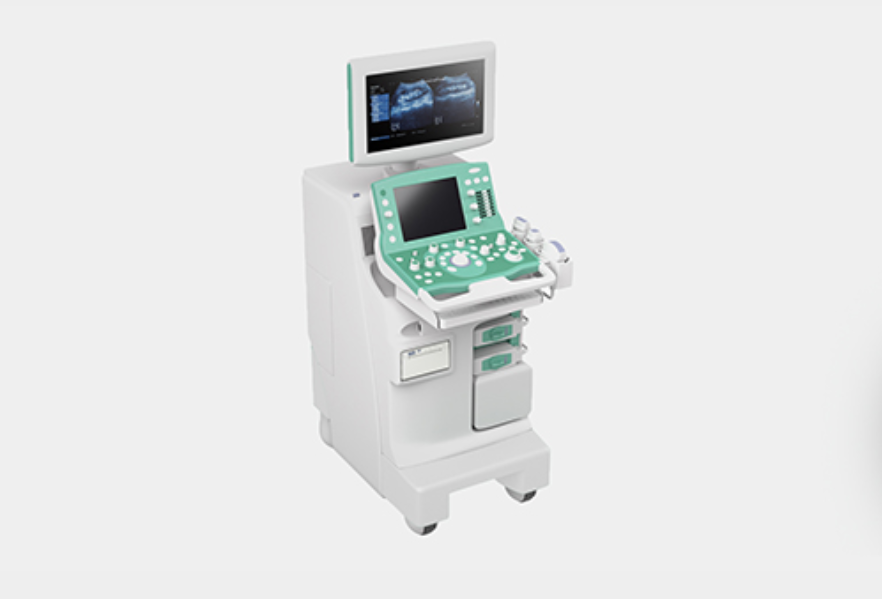
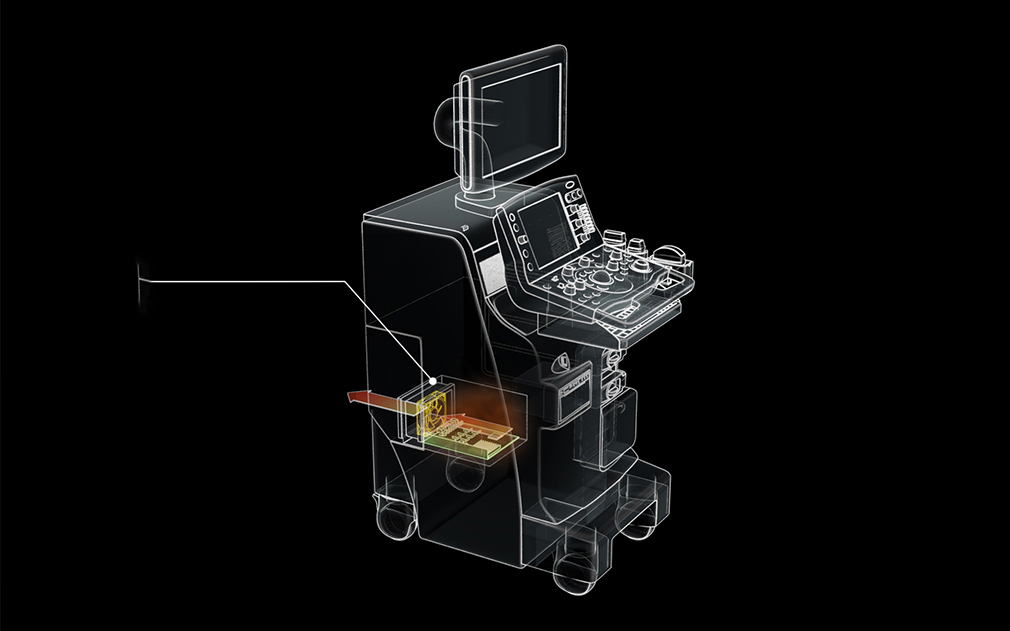
An ultrasound system may contain several heat-generating areas.
| Area | Main Heat Source | Thermal Management Consideration |
|---|---|---|
| Image processing module | High-load data processing | Continuous heat generation |
| Power supply module | Power conversion | Power component heating |
| Main control system | CPU and control ICs | Local temperature rise |
| Signal processing section | Ultrasound signal processing | Extended operating load |
| Display system | Display and driver circuits | Continuous heat generation |
| Interface section | Peripheral and communication circuits | Localized heat |
| Internal chassis | Multiple heat sources | Overall heat accumulation |
This means that the cooling fan is not simply dealing with one concentrated heat source.
It needs to help manage heat generated across multiple areas of the system.
That makes airflow design particularly important.
If air simply circulates inside the chassis without effectively passing through the critical heat-generating areas, a fan with a high rated airflow may still fail to deliver the expected cooling performance in the actual system.
For servers and industrial equipment, cooling fan selection often emphasizes thermal performance.
For medical imaging equipment such as ultrasound systems, however, other factors are equally important:
Reliability, noise, service life, power consumption, and environmental adaptability.
During an ultrasound examination, operators need to continuously observe real-time images.
Excessive fan noise can negatively affect the operating environment.
Therefore, thermal management for medical imaging equipment often requires a balance between several factors:
Cooling performance × Noise × Power consumption × Service life × Reliability
Higher airflow does not automatically mean a better cooling solution.
Higher fan speed does not automatically mean better thermal management either.
The objective is:
A cooling fan is typically a continuously operating component.
As long as the equipment is operating, the fan may also need to operate continuously.
This means the fan itself is exposed to long-term operating conditions.
Potential factors include:
Extended high-speed operation
Continuous bearing operation
Temperature fluctuations
Dust accumulation
Performance degradation
Unexpected fan stoppage
Any of these conditions can affect the overall thermal management system.
After several hours of continuous scanning, the cooling fan is no longer operating under exactly the same conditions as it was immediately after startup.
Therefore, when selecting a cooling fan for medical equipment, several parameters deserve attention.
The expected fan life should be compatible with the equipment's intended operating cycle and service requirements.
Airflow and rotational speed should remain sufficiently stable during extended operation.
Continuous operation should maintain an appropriate acoustic level for the medical environment.
Long operating periods make fan power consumption an important consideration.
Functions such as FG and RD can provide additional information about fan operating conditions.
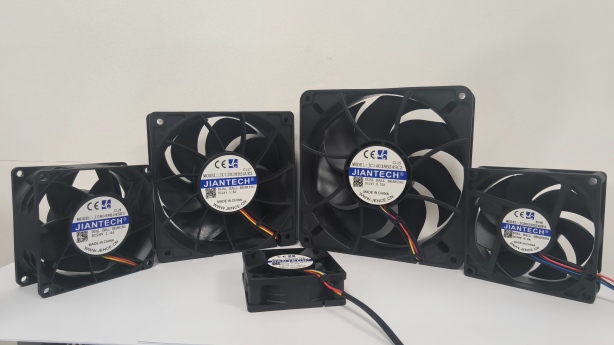
For medical imaging applications, JENTECH focuses on an important question:
After the cooling fan is installed inside the equipment, does it actually solve the thermal management problem?
This is why fan selection should not be based on a single specification.
Several parameters need to be considered together.
Airflow indicates how much air the fan can move over a given period.
Static pressure indicates the fan's ability to maintain airflow when facing system resistance.
Noise affects the acoustic environment during continuous operation.
Fan power consumption becomes relevant during long operating periods.
Fan life affects the long-term reliability of the cooling system.
Fan dimensions must match the available installation space.
Therefore, the JENTECH cooling fan approach emphasizes:
Matching fan performance with the actual operating conditions of the equipment.
The interior of an ultrasound system is not an entirely open space.
It may contain:
PCBs
Power supply modules
Heat sinks
Shielding structures
Mechanical brackets
Cable assemblies
Internal partitions
Protective structures
All of these components can influence airflow.
A basic cooling path may look like this:
Cool air enters
↓
Air passes through the main heat-generating areas
↓
Heat is carried away
↓
Hot air is exhausted
If the airflow path is poorly designed, several problems may occur:
Hot air recirculation
Insufficient airflow in specific areas
Localized thermal accumulation
High fan airflow but limited actual cooling improvement
Therefore, JENTECH considers airflow, static pressure, installation space, and airflow path together when evaluating cooling fan applications.
Simply testing:
“Does the fan spin?”
is clearly not enough.
For an ultrasound system operating continuously, a more important question is:
A continuous thermal test can be used to observe changes over time.
| Test Stage | Key Observation |
|---|---|
| 0–30 minutes | Initial temperature rise |
| 30–60 minutes | Heat transfer behavior |
| 1–2 hours | Internal temperature changes |
| 2–3 hours | Potential continuous heat accumulation |
| 3–4 hours | Approach toward thermal equilibrium |
| After 4 hours | Extended operating stability |
The actual test duration should be determined according to the equipment's operating conditions and applicable validation requirements.
For a thermal management system, the ideal result is not necessarily that temperature continues to decrease.
Instead:
After a certain period of operation, internal temperatures should gradually approach a stable condition and remain within the equipment's design limits.
This is a more meaningful indication that the thermal management system is working effectively.
For medical imaging equipment, JENTECH can evaluate cooling fan solutions according to the actual equipment requirements.
Medical imaging equipment often has limited internal space that must accommodate mechanical structures, electrical components, safety requirements, and service access.
Therefore, fan dimensions need to match the actual installation space.
Depending on the equipment structure, solutions can range from compact DC axial fans to larger high-airflow cooling fans.
If the equipment contains filters, heat sinks, narrow airflow channels, or other structures that increase resistance, static pressure becomes particularly important.
This is especially important for compact medical equipment.
Ultrasound examination environments require a relatively controlled acoustic environment.
Therefore, a cooling fan should not only:
Move air effectively
but also:
Operate quietly and consistently.
JENTECH continues to focus on low-noise fan design and application matching for equipment where acoustic performance matters.
An ultrasound system does not necessarily operate at the same load level at all times.
Standby operation, routine scanning, and high-load image processing can produce different thermal conditions.
PWM control can allow fan speed to be adjusted according to the actual thermal load.
For example:
Low load → Lower fan speed
Temperature increases → Fan speed increases
High load → Increased cooling capacity
This can help balance cooling performance, noise, and power consumption.
For medical equipment that needs to operate reliably over extended periods, monitoring fan status can also be valuable.
FG can provide information about the fan's actual operating speed.
RD can help identify abnormal fan operating conditions.
For medical equipment, this type of feedback helps transform the cooling fan from a simple continuously running component into:
A monitored subsystem within the equipment's thermal management architecture.
During technical communication and application development related to medical equipment cooling, JENTECH has increasingly focused on one important point:
The actual cause may be related to:
Improper airflow design
Incorrect fan installation position
Excessive outlet resistance
Hot-air recirculation
Concentrated heat sources
Insufficient static pressure
Airflow not reaching the areas that actually require cooling
Therefore, thermal optimization often requires an analysis of the complete equipment structure.
For example:
A medical imaging system may experience relatively high local temperatures during extended operation.
Simply increasing fan speed may provide more airflow, but it can also increase noise and power consumption.
A more systematic approach is to examine:
Heat source → Airflow path → Fan installation direction → Air inlet and outlet → Airflow → Static pressure → Temperature rise
The fan can then be selected and the airflow structure optimized accordingly.
The objective is not:
“Install a larger fan.”
It is:
In practical medical equipment cooling projects, JENTECH focuses on the overall equipment performance rather than fan specifications alone.
Prototype testing can evaluate:
Compare temperature changes in key heat-generating areas before and after thermal optimization.
Evaluate effective airflow under the equipment's actual airflow resistance.
Verify whether the fan can overcome resistance created by internal structures.
Evaluate overall equipment noise during continuous operation.
Assess cooling energy consumption during extended operation.
Observe whether internal temperatures continue to accumulate over extended operating periods.
Ultimately, a complete medical equipment cooling solution should answer several practical questions:
Has temperature rise been improved?
Is the noise level appropriate?
Does the system remain stable during extended operation?
Can the cooling system maintain reliable operation over the expected service period?
Specific temperature, noise, service-life, and reliability results should be based on actual prototype testing and final validation data.
For JENTECH, medical equipment cooling is not simply another application category for a fan.
The requirements for stability, low noise, and long-term operation mean that the cooling fan must be selected according to the actual operating conditions of the equipment.
A small cooling fan involves much more than airflow.
Behind it are considerations involving:
Thermal management, aerodynamics, motor technology, bearings, mechanical structure, noise, control, and reliability.
Therefore, JENTECH aims to provide more than:
“A cooling fan that matches the required dimensions.”
The goal is to participate more deeply in equipment thermal management design.
From the prototype stage, important questions include:
Where are the heat sources?
Where does cool air enter?
Which heat-generating components does the airflow pass through?
Where does the hot air exit?
How much airflow is required?
How much static pressure is required?
Is PWM control required?
Are FG/RD feedback functions required?
How should noise and service life be evaluated during extended operation?
Once these requirements are defined, the appropriate cooling fan solution can be evaluated.
As medical ultrasound systems move toward:
Higher performance, greater integration, more powerful image processing, and more compact designs,
internal power density may continue to increase.
Thermal management will therefore need to evolve accordingly.
Future cooling fans may no longer simply follow the basic logic of:
Power on → Fan runs → Heat is exhausted
Instead, the cooling system may increasingly interact with the equipment's control system.
For example:
Automatically adjust fan speed according to internal temperature.
Adjust fan speed according to equipment workload.
Monitor actual fan operating speed.
Identify fan stoppage or abnormal operating conditions.
Reduce fan speed when thermal demand is low, minimizing unnecessary noise.
These are also among the areas JENTECH continues to explore in future product and application development.
The future direction of medical equipment cooling is not simply about achieving increasingly higher airflow.
For ultrasound systems and other medical imaging equipment, several areas deserve greater attention.
Deliver more effective heat removal within limited installation space and power constraints.
Reduce the acoustic impact of the cooling system during continuous operation.
Develop fan solutions that better match the long-term operating requirements of medical equipment.
Continue improving cooling solutions for the actual operating environments of medical equipment.
Use PWM, FG, and RD functions to create closer interaction between the cooling fan and equipment control system.
Develop cooling fan solutions based on the dimensions, airflow paths, heat sources, and operating conditions of different medical imaging systems.
The real-time images displayed on an ultrasound system may appear to be the direct result of probe acquisition and image processing.
Behind those images, however:
The processor is continuously calculating.
The power supply is continuously operating.
The signal processing system is continuously working.
And the cooling fan is continuously moving air.
When an ultrasound system operates continuously for four hours, eight hours, or even longer, what is truly being tested is not simply the instantaneous performance of one component.
It is whether the entire system can continue operating reliably.
For medical ultrasound equipment, the probe cannot easily “drop offline,” image processing cannot simply freeze, and the control system cannot unexpectedly stop.
The cooling system also needs to remain dependable when it is needed most.
A cooling fan may be only a small component inside a medical imaging system.
But its continuous and reliable operation contributes to the long-term stability of the entire equipment platform.
JENTECH will continue to focus on high-reliability applications including medical imaging, industrial automation, robotics, and new energy equipment, with ongoing attention to cooling fan airflow, static pressure, noise, service life, intelligent control, and environmental adaptability.
The goal is to help cooling fans evolve from simple air-moving components into more reliable and controllable elements of equipment thermal management.
Four hours of continuous scanning should not be a challenge for the cooling system.
Every stable frame and every diagnostic examination relies on reliable thermal management working continuously in the background.
This is what the JENTECH cooling fan solution aims to support:
Uses high-frequency sound waves to produce diagnostic images in real time.
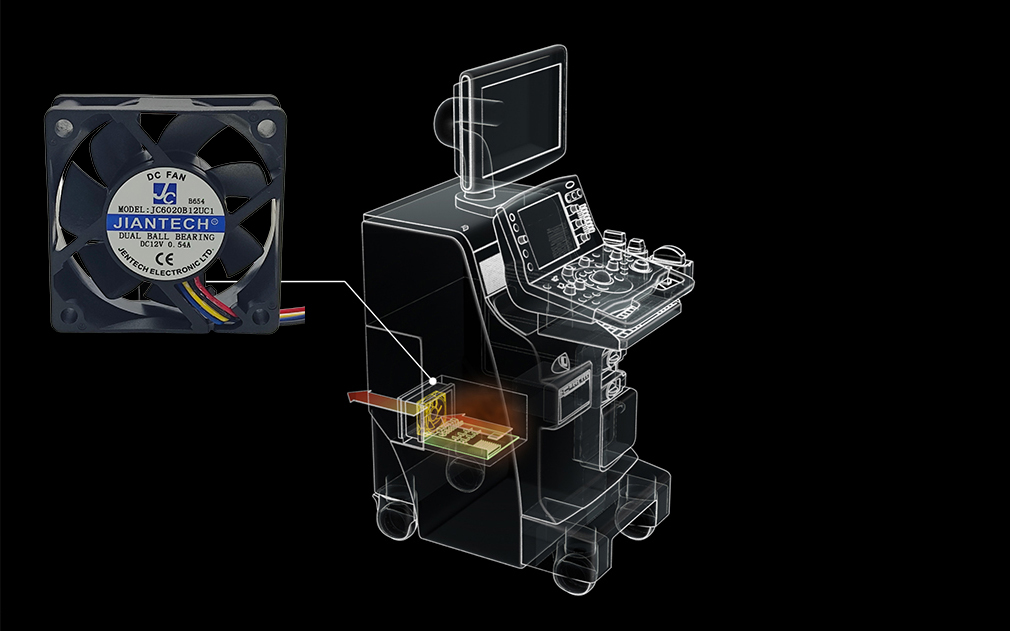
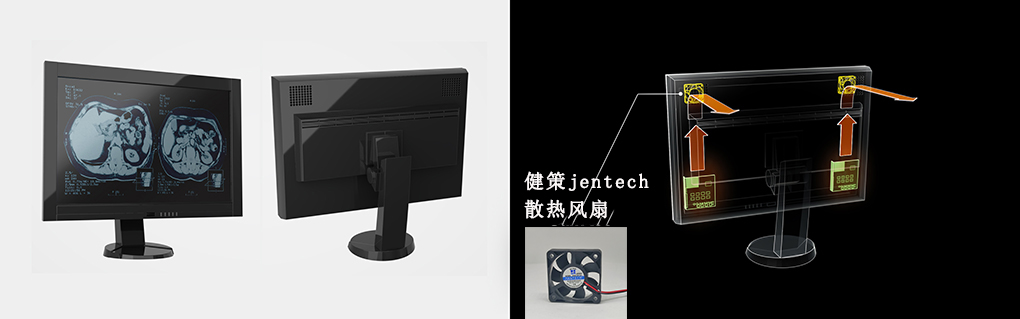
Designed to remove heat from the control panel and internal electronic components, helping maintain stable operating temperatures during continuous equipment operation.
Contact:
Phone: 18124620466
Tel: 0755-23706799
Email: yq@jentech.cn
Add: